


19-year-old boy from Bihar develops a 5.82B multimodal AI model using Rs 11 lakh from personal savings
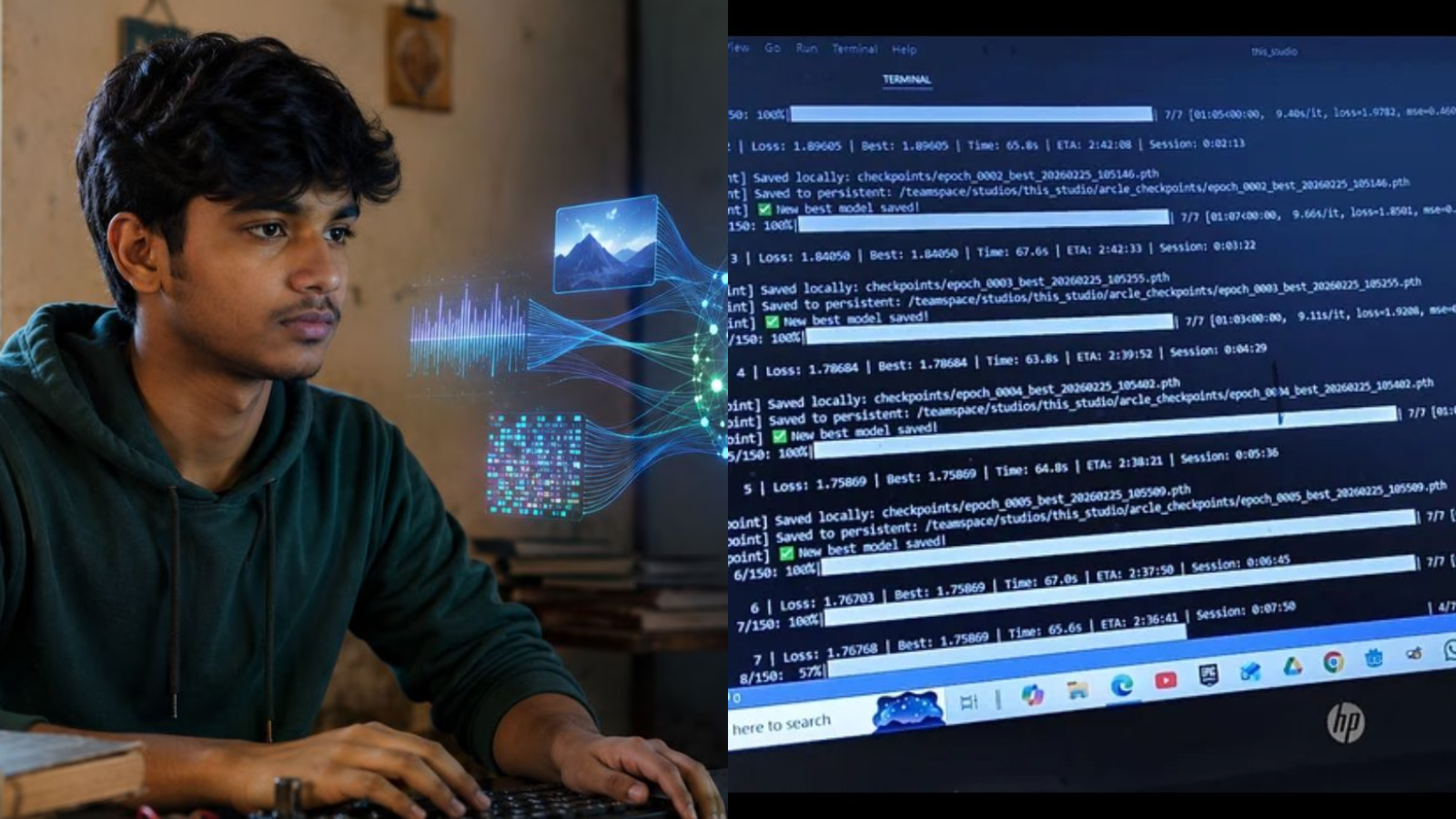
In an era dominated by tech giants pouring billions into artificial intelligence, a 19-year-old Class 12 student from Bihar has captured national attention with an audacious solo project. Abhinav Anand claims to have developed a 5.82-billion-parameter multimodal AI model, using roughly ₹11 lakh sourced primarily from personal and family savings, supplemented by cloud credits and compute grants.
Just two-and-a-half years ago, Anand’s knowledge of AI was limited to hearing about ChatGPT. Hailing from a middle-class family—his father a government officer and mother a homemaker—he began experimenting while juggling school. Early attempts included a YouTube analytics tool (inspired by his own gaming content creation), a voice assistant, and an offline AI system. Many failed, but each taught valuable lessons. He even trained a text-to-video model on a regular laptop before scaling up.
ArcleIntelligence stands out as a true multimodal system. According to Anand, it processes and integrates text, images, documents, audio, and video inputs while generating outputs like text, 512x512 images, and 24kHz speech. It boasts a massive context window exceeding 2 million tokens and reportedly scored 93.45 on the OmniDocBench V1.5 benchmark in private testing (results unverified independently). The architecture reportedly combines specialist models with a shared reasoning backbone, using hybrid techniques like state space models and attention mechanisms.
The financial journey underscores the sacrifice. GPU compute alone cost around ₹64,000–₹1.2 lakh, money Anand had saved for a gaming laptop. He relied on RunPod grants, DigitalOcean credits, and GitHub Student Pack resources. No investors, no team, no formal CS degree—just relentless self-learning through trial and error, often at the expense of sleep and exams.
The project remains under training. Anand is seeking about $35,000 to complete it and plans to open-source the model weights on Hugging Face and the codebase on GitHub, aiming to boost India’s presence in foundation models. “The West has OpenAI. The East has DeepSeek. India deserves its own,” he wrote.
admiration for the ambition and grit from a small-town teenager, alongside skepticism. Critics question transparency on datasets, training details, and code quality, with some calling parts “vibe-coded.” Others note the lack of a detailed public journey prior to the announcement. Yet many celebrate the story as proof that cutting-edge AI experimentation is no longer confined to elite labs or metros.
This tale resonates deeply in India’s evolving AI landscape. With a massive developer base, stories like Anand’s highlight how determination and accessible tools (cloud credits, open resources) can empower young innovators from anywhere. Success isn’t guaranteed—training and benchmarking large models is notoriously hard—but the effort itself inspires.
Whether ArcleIntelligence becomes a production-ready breakthrough or a learning milestone, Abhinav Anand’s journey reminds us: innovation often starts in unlikely places, fueled by curiosity and sacrifice rather than deep pockets. India’s next AI leap might just come from a bedroom in Bihar.